
Alarms, warnings, and panic surround you as you make your way to an escape pod to quickly blast from the plunging depths of an unknown ocean to the surface. Then you stick your head out of the pod to be greeted by a vast expanse of water stretching into the horizon.
So it’s business as usual for Subnautica 2, following in the footsteps (or should that be fin flaps) of its predecessor; sea-based survival game Subnautica. Only rather than the burning wreckage of a giant ship in view, Subnautica 2 has a mushroom-shaped coral structure as its focal point, suggesting things could get a lot more weird.

For a start, you’re no longer a lone survivor; rather you’re awoken by AI system Noetic Advisor (NoA) and designated as a ‘Qualified Investigator’ tasked with working out why you’re not on the intended planet your colony ship was targeting, why there’s no colony established, and finding out if you’re not the first to be awakened from an artificial slumber, then to establish a foothold on this watery planet for the colonists still asleep leagues below the sea.
All that’s quite an ask for someone in a tiny pod with only a few bits of kit. Fortunately, you’re armed with a fabricator that can make quite a bit from harvested materials.
Sea scraping

So you pop the hatch and get exploring
You’ll plunge into the drink to collect basic materials, like scrap metal and bits of flora and fauna, returning to the escape pod and its fabricator to make basic tools and kit, as well as food and water. Subnautica 2 is still very much a survival game where you have to keep an eye on your QI’s hunger and hydration levels unless you want to slowly creep towards death.
I found the process of accumulating stuff to be a little more intuitive than that of the first game, with a feeling like you know what materials you’re going to get when you swipe or grab at a plant or rocky outcrop.

Poking around more of the starting area reveals blueprints for new items for the fabricator to… fabricate, eventually leading you to a scanner.
From here you can scan pretty much anything and everything, revealing more information about the various plants and aquatic life around you. More importantly, this lets you scan other objects and equipment left by previous colonists who were also trying to survive on an unexpected and unknown planet.
Doing this soon unlocks base building, which is a key to really getting into Subnautica 2.

Base building has been improved and streamlined in that you can now modify components like rooms and corridors, stretching or narrowing them, as well as having the means to move and relocate modules, which should prove to be a nice upgrade for players coming from the more rigid templates of Subnautica.
As base building moves the game forwards, I definitely appreciated the flexibility to building; not least of all because I borked the layout of my initial base by missing a blueprint for a room module and trying to fudge together a structure of corridors.
Diving deeper, familiar feelings

I will say that knowing how to advance objectives might not be immediately clear to newcomers.
After some initially very obvious objectives, like seeking out a black box from another would-be colonist, a lot of information is squirrelled away in menus of the QI’s PDA. This may be by design, and I liked digging around for clues but the odd nudge on what to do next might be appreciated by folks without an abundance of patience.
Equally, there’s a lot other information that gets thrown one’s way. A computer voice linked to the in-game PDA gives you pings of when you’re running low on oxygen or need substance, which can be handy if you’re focusing on what’s out in the deep blue than the info on the HUD. But another robotic voice, the third in the game so far once one counts the PDA and NoA voices, constantly tell you about the status of your base when you’re near it or welcomes you aboard each time you go in and out even for the briefs of moments, which can get a little grating.
If this is sounding very familiar to Subnautica then you’d be right; in its early access stage, Subnautica 2 is understandably a work in progress and the things to separate it more distinctly from its predecessor are likely to come later on down the line.
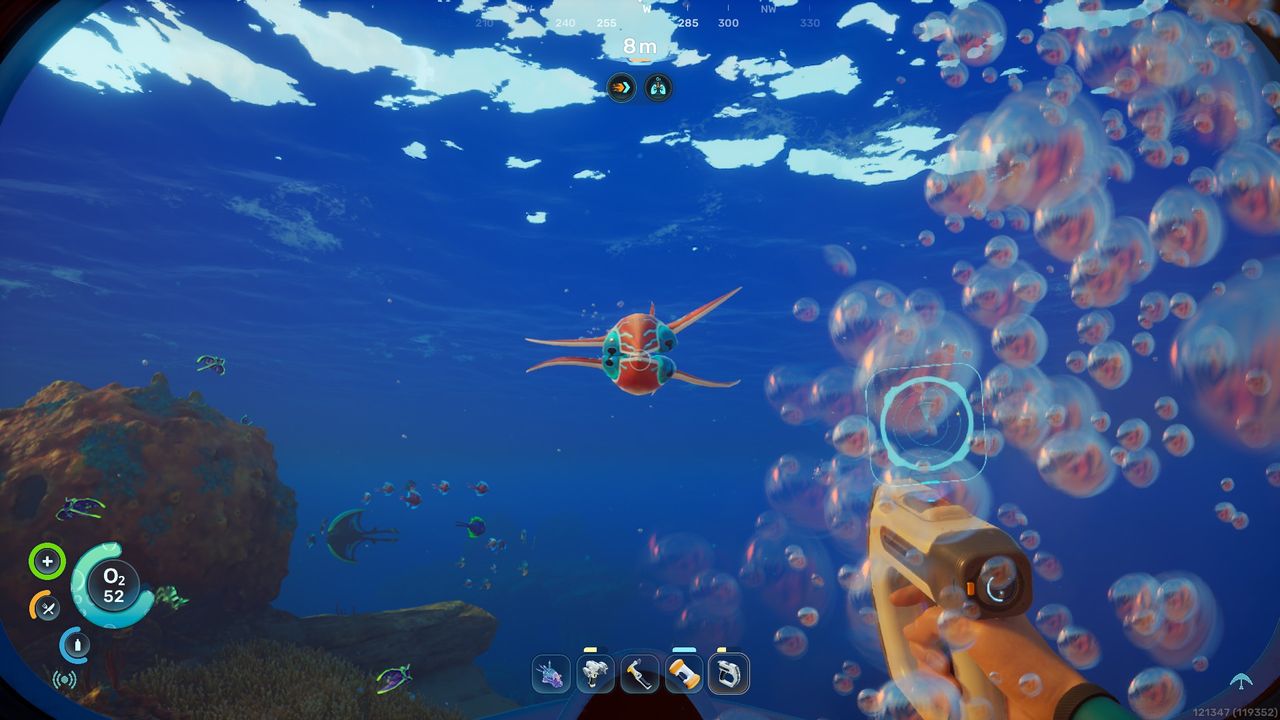
While there’s the promise of much larger and diverse biomes and things to explore in the future, where Subnautica 2 feels fresher is in the sea life. There’s just a lot more to see, and it feels like you’re diving into an aquatic ecosystem then just a watery world with a handful of marine creatures big and small.
To me, the life in Subnautica 2 feels, well… more alive. I’m not sure there are super-deep systems at play governing the sea life, but they feel more interactive and reactive to each other.


It’s great to look at too, with more advanced lighting and geometry courtesy of Unreal Engine 5 offering a visual upgrade over Subnautica, but retaining the game’s art style. This did mean that I found Subnautica 2 doesn’t run all that well on my Steam Deck; it’s playable but feels a bit jerky and stuck around 30 frames per second. I hope Unknown Worlds can do a bit more optimization for one of my favourite gaming devices.
I also feel there’s more potential to the story, even if some of it feels a tad tropey. The NoA AI is more emotionally charged than one might expect of a clever computer, leading you to naturally feel less inclined to trust it.
As you push out to failed outposts more story chunks pop up as you uncover what’s happened to previous QIs and colonists.
This made me wonder if this will be a story about a rogue AI system. But then there’s the whole system of acquiring adaptations from alien life so that your QI can survive the rigours of this planet.
Naturally, this led me to wonder if the story will have more of a pseudo body-horror element, as one wonders how far away the player character is going adapt from being a true human.

On top of this, there’s a strangeness to Subnautica 2’s flora and fauna that, oddly enough, reminds me a little of the fugal life in Keeper; usually such weird life is seen as more of a danger than potentially a key part of the ecosystem.
This is complicated further given there’s a virus that’s infecting and effecting the world, with some areas being dense with “viral bloom”. It’s unclear if this is a planet under ecological collapse or if a state of equilibrium has been established.
I reckon if Subnautica 2 can blend all these elements together it could have a story that is well worth plumbing the depths of.
Eye on the horizon

And that’s where I’ve landed with the game as it stands; there’s plenty of scope to Subnautica 2 to build on already solid foundations of its predecessor, and that of its early access state. More biomes and areas to explore, a fully fledged story, extra tools and things to build and discover could all make for a superb successor to a hit in the survival game genre.
The question is should you play it now or wait? I think if you’re a one-and-done type of player, it’s worth waiting for the full release of Subnautica 2; such a date for that hasn’t been marked yet.
If you’re a fan of the original and have been itching for a new sea-centric survival soirée, then Subnautica 2 can offer you a good 20 hours of exploring, and more if you’re a big base builder.
On top of this, and I appreciate I’ve buried the lede here, there’s a co-op mode so you and a pal can try your hands at surviving together. I’ve not been able to test this, but I imagine it’ll make for a less isolating experience and easier resource collection.
So there’s a lot to like with Subnautica 2, and I’ve enjoyed my dive into it. But I’m also awash with enthusiasm to see how it builds across the early access stage into its full release.